

What to Expect for Sustainable and Eco-Friendly Office Design
Sustainability has become an important consideration for businesses planning new offices, refurbishments and workplace upgrades. Modern office design services can help organisations reduce energy and water consumption, choose more responsible materials and create healthier environments for employees. Instead of treating sustainability as a collection of individual green features, the strongest approach considers how the entire workplace will function throughout its lifecycle.
An eco-friendly office also needs to work practically for the people using it. Energy efficiency means little if employees are uncomfortable, while sustainable furniture provides limited value if the layout needs to be replaced whenever the company grows. Businesses should therefore expect their design team to balance sustainability with workflow, flexibility, employee wellbeing, budget and long-term operational requirements.
What Should Sustainable Office Design Services Include?
Sustainable office design services should begin with an assessment of how the organisation currently uses its space. Designers need to understand employee numbers, departmental relationships, workflows, occupancy patterns and future growth before recommending materials or technologies. This prevents sustainability from becoming a checklist of products that may not suit the actual workplace.
The design team should then consider the building as a connected system. Lighting affects energy consumption, layouts influence how much floor area needs to be cooled, furniture affects adaptability and material choices influence waste and indoor air quality. Research cited across sustainable workplace guidance suggests that energy-efficient systems and smarter controls can cut office energy consumption by around 30% in suitable buildings.
A comprehensive sustainable design service should consider areas such as:
- Space planning and efficient use of floor area
- Energy-efficient lighting and HVAC systems
- Natural daylight and ventilation
- Water-saving fittings
- Sustainable and low-emission materials
- Modular and durable furniture
- Waste reduction and recycling
- Employee comfort and wellbeing
- Future adaptability
- Lifecycle costs and maintenance requirements
These elements should not be treated independently. For example, improving access to daylight can reduce artificial lighting demand while also creating a more pleasant working environment. Similarly, reducing the amount of unnecessary floor space can lower furniture requirements, construction materials and the amount of space that must be heated or cooled.
Businesses should also expect their design provider to explain priorities rather than recommending every possible sustainability feature. The most effective interventions will depend on the building, available budget, workforce and operational goals. A good strategy focuses investment where it can deliver the greatest practical, financial and environmental benefits.
Start With Smarter Space Planning
Space planning is one of the most practical ways to improve sustainability because inefficient layouts increase both property costs and resource consumption. A business occupying more space than it needs pays for additional lighting, cooling, cleaning, furniture and maintenance. Better analysis of occupancy and workflow can reveal whether existing floor area can be used more effectively.
Hybrid working has made this particularly important. Many organisations no longer have every employee in the office simultaneously, which means a workplace designed around one dedicated desk per person may contain significant unused capacity. Flexible workstations, shared meeting facilities and multipurpose rooms can help businesses extract greater value from the same floor plate. Efficient planning can therefore contribute both to lower environmental impact and better control over long-term property expenditure.
Expect Energy Efficiency to Be Part of the Design
Energy consumption is one of the most measurable areas of sustainable workplace design. LED lighting, occupancy sensors and daylight-responsive controls can reduce unnecessary electricity use by ensuring lighting operates only when and where it is required. Modern LED fittings can also use substantially less energy than older lighting technologies while typically lasting longer.
Heating, ventilation and air-conditioning systems should receive similar attention because HVAC can represent a substantial share of commercial building energy consumption. Smart controls, zoning and occupancy-based operation can prevent entire floors or meeting areas from being cooled when they are empty. Some sustainable workplace sources estimate that well-designed energy-management measures can reduce consumption by around 30%.
For South African businesses, energy planning can also support resilience. Solar PV, battery storage and efficient equipment can reduce dependence on the grid while providing greater protection against power interruptions and rising utility costs. Sustainable office design services should therefore consider both environmental performance and business continuity when evaluating energy systems.
Choose Sustainable Materials Carefully
Material selection can have a significant environmental impact because every office fit-out involves extraction, manufacturing, transportation and eventual disposal. Sustainable design should prioritise products with recycled content, reclaimed materials, responsibly sourced timber and components that can remain in use for many years.
Indoor health is another important consideration. Low-VOC paints, adhesives and finishes can reduce the amount of volatile organic compounds released into occupied areas. This matters because employees may spend thousands of hours inside the workplace every year, making indoor air quality an important part of both sustainability and employee wellbeing.
Businesses can consider:
- Recycled-content materials
- Responsibly sourced timber
- Reclaimed wood
- Recycled metals
- Low-VOC paints and adhesives
- Durable floor finishes
- Locally sourced products where practical
- Materials that can be repaired or refinished
- Products that can eventually be recycled
- Finishes requiring limited maintenance
Durability should carry as much weight as environmental credentials. A product marketed as sustainable provides limited value if it deteriorates quickly and needs to be replaced after only a few years. Long-lasting materials can reduce future purchasing, transport and installation requirements.
Businesses should therefore ask suppliers and design teams about expected service life, maintenance and disposal alongside appearance and cost. Sustainable specification is strongest when materials can perform reliably throughout the useful life of the workplace.
Consider Furniture as a Long-Term Investment
Furniture can represent a significant portion of an office fit-out budget, which makes replacement cycles an important sustainability issue. Workstations, chairs, storage and meeting furniture that become obsolete every time the office layout changes can create unnecessary waste and recurring capital expenditure.
Furniture should instead be viewed as part of the long-term workplace strategy. Modular products can often be reconfigured as teams expand or contract, while repairable components can extend useful life. This reduces the need to dispose of complete furniture systems simply because one part has failed or the layout has changed.
Businesses should prioritise furniture that offers:
- Modular construction
- Replaceable components
- Durable finishes
- Reconfigurable workstation layouts
- Appropriate ergonomics
- Efficient use of floor space
- Recyclable or reusable materials
- Easy maintenance
- Compatibility with future growth
- Long expected service life
Custom furniture can also improve sustainability when it allows awkward or underused areas to become productive space. Storage, seating and workstations can be designed around the dimensions of the workplace rather than forcing generic products into unsuitable locations.
By coordinating furniture with space planning, workflow and future growth, businesses can create interiors that remain useful for longer and reduce the likelihood of unnecessary replacement.
Improve Water Efficiency
Water-saving measures are increasingly relevant to sustainable offices, particularly in regions where water security can become a business risk. Dual-flush toilets, low-flow taps and efficient kitchen fittings can reduce daily consumption without requiring employees to significantly change their routines.
Even small leaks can create substantial waste over time. A single continuously leaking fitting may waste thousands of litres before somebody notices the problem. Sustainable workplace planning should therefore include maintenance access and regular inspection rather than relying only on efficient fixtures at the time of installation.
More advanced projects may also consider greywater harvesting or other water-reuse systems where the building allows it. In South Africa, where major cities have experienced severe water restrictions in recent years, combining efficiency with water resilience can strengthen both environmental performance and business continuity.
Create Healthier Indoor Environments
Employees can spend roughly 8 hours a day inside the workplace, making indoor environmental quality an important design consideration. Natural light, ventilation, comfortable temperatures and appropriate acoustics can all influence how people experience the office.
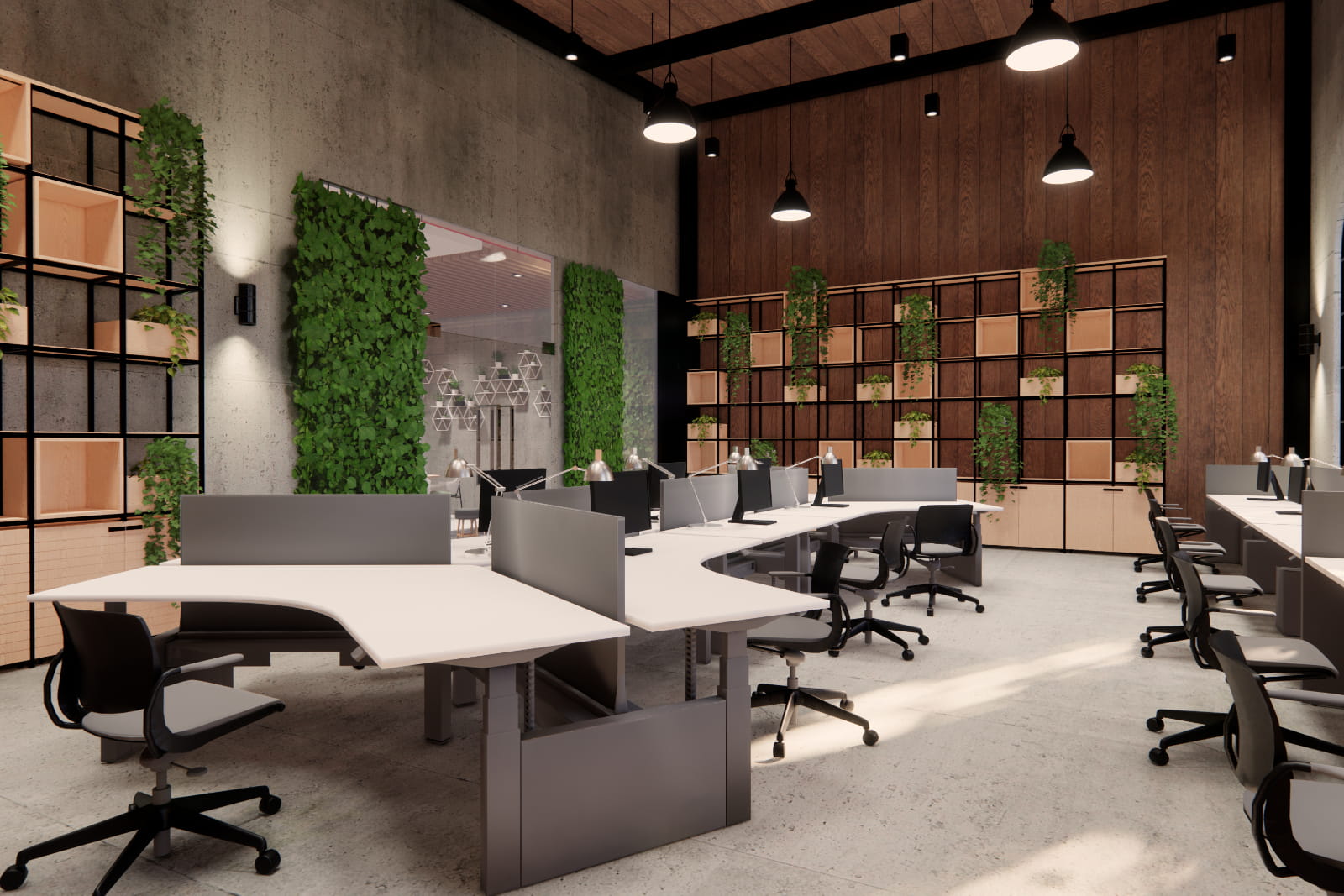
Biophilic design can support this by introducing plants, natural materials and visual connections to nature. Sustainable workplace research frequently links these elements with improved wellbeing and concentration. Some workplace design studies have reported productivity improvements of around 15% when environments include stronger natural elements and better environmental conditions, although results vary between organisations.
Indoor comfort also depends on practical details such as air movement, glare and noise. An energy-efficient workplace that is too hot, poorly ventilated or acoustically disruptive will struggle to support employees effectively. Sustainable design therefore needs to balance resource efficiency with human performance.
Design the Office to Adapt Over Time
One of the most sustainable offices is one that can continue serving the business for many years. Organisations change as staff numbers fluctuate, hybrid working evolves and new technologies influence how employees operate. A rigid layout may require extensive reconstruction every time one of these changes occurs.
Adaptability reduces this risk. Movable partitions, modular workstations and multipurpose areas make it easier to change how space is used without demolishing major parts of the existing fit-out. This can substantially reduce future material waste and renovation costs.
Useful adaptability measures can include:
- Modular workstation systems
- Movable partitions
- Multipurpose meeting rooms
- Shared collaboration zones
- Flexible storage
- Reconfigurable furniture
- Accessible power and data infrastructure
- Areas that can support different team sizes
- Expandable departmental layouts
- Designs that allow future technology upgrades
These features can be particularly valuable in fast-growing businesses. Instead of rebuilding an office every time a team adds several employees, adaptable spaces can absorb moderate organisational changes with relatively minor adjustments. By looking beyond immediate headcount, businesses can reduce the risk that today’s fit-out becomes unsuitable within only a few years.
Reduce Construction and Operational Waste
Commercial fit-outs can generate significant quantities of waste when partitions, flooring, furniture and fittings are removed. Sustainable projects should assess what can be retained, refurbished or recycled before sending existing materials for disposal.
Operational waste matters too. One sustainability source estimates that an office employee can generate around 1 kg of waste per day. Across a workplace with 100 employees, that could equate to approximately 100 kg each working day, showing why recycling, procurement and reusable products deserve attention.
Design can support better habits by providing convenient recycling stations, suitable storage and shared facilities. Sustainability is easier to maintain when the workplace makes responsible behaviour practical rather than relying entirely on employees to develop their own systems.
Think About the Entire Lifecycle of the Workplace
Upfront price is only one part of what an office costs. Lighting consumes electricity for years, furniture requires maintenance and flooring may eventually need replacement. Sustainable design therefore looks at how a product or design decision will perform throughout its useful life.
Lifecycle thinking can also reveal situations where spending slightly more initially produces better long-term value. Efficient equipment, durable materials or adaptable furniture may involve higher upfront costs but require fewer replacements and lower operating expenses later.
When evaluating lifecycle value, businesses should consider:
- Initial purchase cost
- Energy consumption
- Water consumption
- Maintenance
- Expected lifespan
- Repairability
- Replacement frequency
- Adaptability
- Disposal costs
- Reuse or recycling potential
This approach is especially important when comparing products with different expected lifespans. A cheaper finish that needs replacement twice during the useful life of a more durable alternative may ultimately consume more materials and money.
Some sustainable property research also suggests that green-building certification can support property values, with certain studies reporting premiums of around 7%. Actual returns depend on the market and building, but the figure demonstrates why sustainability increasingly forms part of long-term asset planning rather than simply environmental reporting.
Incorporate Brand and Culture Into Sustainable Design
Sustainability does not require offices to look the same. An organisation can still express its brand through colour, materials, graphics and furniture while choosing options that are durable and environmentally responsible.
Culture should also influence layout. A collaborative company may need more shared project areas, while employees performing concentrated technical work may require quieter spaces. Designing around real working behaviour reduces the chance that spaces will later need expensive alteration.
What Should You Ask an Office Design Provider?
Choosing the right design provider requires more than comparing visual portfolios. Businesses should find out how sustainability will influence planning, materials, procurement, construction and long-term operation. It is particularly important to understand whether recommendations are based on the client’s actual workplace requirements.
Budget transparency should also be discussed early. Sustainable features may sometimes increase upfront costs, while others can produce immediate savings through reduced material use or better space efficiency. A provider should be able to explain these trade-offs clearly.
Useful questions include:
- How will you assess our current space usage?
- Which sustainability measures will deliver the greatest benefit?
- How will energy efficiency be incorporated?
- How do you evaluate materials and finishes?
- Can existing furniture or materials be reused?
- How will the office accommodate future growth?
- How are project costs monitored?
- Who manages construction and procurement?
- How will waste be reduced during the fit-out?
- What ongoing maintenance should we expect?
Businesses should also establish how many separate parties will be responsible for delivery. Fragmented projects can make it harder to ensure that the original sustainability strategy survives procurement and construction.
A coordinated design and build provider can maintain greater continuity between concept, specification and implementation. This is particularly useful where decisions about space planning, furniture, construction and building modifications affect one another.
Who Offers Sustainable and Eco-Friendly Office Design Services?
At Turnkey Interiors, we provide office design services that bring space planning, interior design, costing, construction, custom furniture and project management into one coordinated process. We were established in 2001 and operate from Johannesburg and Cape Town, giving us 25 years of experience in commercial workplace projects.
Our approach starts with understanding how each organisation actually works. We consider staff requirements, workflow, departmental relationships, available space and expected growth before moving into detailed design. This helps us identify opportunities to use floor area more efficiently while developing a workplace that supports employees and the company’s brand.
We can also integrate sustainability throughout the wider project rather than treating it as an isolated design feature. Responsible materials, adaptable layouts, custom furniture, efficient space planning and building upgrades can all form part of the solution. Because we coordinate design, costing, procurement, implementation and handover, we can help clients balance sustainability goals with practical requirements and available budgets.
Why Project Coordination Matters
A sustainable concept is only useful if it survives construction. Materials may become unavailable, unexpected site conditions can emerge and budgets may need adjustment. Each of these changes creates opportunities for sustainability objectives to be weakened.
Coordination becomes especially important when several contractors and suppliers are involved. Design decisions regarding lighting, furniture, partitions and mechanical systems frequently affect one another, which means changes made by one team can create problems elsewhere.
A coordinated project should include:
- Clear project responsibilities
- Detailed cost planning
- Construction programmes
- Procurement management
- Regular site reporting
- Quality control
- Health and safety oversight
- Design coordination
- Management of specification changes
- Final commissioning and handover
When one project team understands the overall design intent, alternatives can be evaluated according to performance as well as price. This reduces the risk that a cheaper substitution undermines the project’s long-term environmental or functional objectives.
Responsible, Sustainable, and Adaptable
Choosing sustainable office design services is about creating a workplace that performs responsibly over the long term. Energy and water efficiency matter, but businesses should also consider adaptable space planning, employee wellbeing, durable materials, furniture lifecycle and construction waste. With measures such as intelligent energy controls potentially reducing consumption by around 30%, sustainability can create operational benefits alongside environmental ones.
At Turnkey Interiors, we can help you plan, design and deliver a workplace that balances sustainability with functionality, brand identity, employee requirements and budget. From early space planning and concept development through to custom furniture, construction and final handover, we provide a coordinated approach to workplace projects. Get in touch with us to discuss how we can create a more sustainable, flexible and practical office for your organisation.
FAQs About Office Design Services
What Are Sustainable Office Design Services?
Sustainable office design services focus on creating workplaces that reduce environmental impact while supporting employees and business operations. This can include efficient space planning, energy-saving lighting, responsible material selection, low-VOC finishes, water-efficient fittings, adaptable furniture and better use of natural light. Designers may also consider how the office can accommodate future growth without requiring major renovations. A sustainable approach looks beyond appearance and considers energy consumption, waste, maintenance and the lifecycle of materials and furniture. The aim is to create a practical workplace that performs efficiently, remains useful for longer and supports wider sustainability goals.
How Can Office Design Services Make a Workplace More Eco-Friendly?
Office design services can make a workplace more eco-friendly by reducing unnecessary energy, water and material consumption. Designers may improve layouts to maximise natural light, specify LED lighting and occupancy controls, select durable recycled or responsibly sourced materials and introduce water-saving fittings. Furniture can also be chosen for longevity, repairability and flexibility so that it does not need frequent replacement. Efficient space planning can reduce the total area that requires lighting, cooling and furnishing. The best results come from considering sustainability during the early planning stages, allowing environmental measures to be integrated naturally into the overall design and construction process.
Are Sustainable Office Design Services More Expensive?
Sustainable office design services are not necessarily more expensive over the full lifecycle of a workplace. Some materials, systems or technologies may require higher upfront investment, but they can reduce energy use, maintenance and replacement costs over time. Durable flooring, modular furniture and efficient lighting, for example, may remain useful for longer and require fewer upgrades. Good space planning can also help businesses avoid paying for unnecessary floor area. The key is to assess lifecycle value rather than purchase price alone. A design provider should help businesses prioritise sustainable improvements that provide practical benefits without pushing the project beyond its available budget.
What Materials Are Best for Sustainable Office Design?
The best materials for sustainable office design are durable, responsibly sourced and suitable for reuse, repair or recycling. Common options include reclaimed timber, recycled metals, recycled-content boards and timber from responsibly managed sources. Low-VOC paints, adhesives and finishes can also support healthier indoor air quality. Businesses should consider how far materials need to travel, how much maintenance they require and how long they are expected to last. A product described as environmentally friendly may offer limited value if it needs frequent replacement. Sustainable office design services should therefore evaluate appearance, durability, sourcing, emissions, maintenance and end-of-life options before recommending materials.
How Do I Choose a Sustainable Office Design Services Provider?
Choose a sustainable office design services provider that can explain how environmental considerations will be incorporated into planning, materials, construction and long-term operation. Ask how the team evaluates space efficiency, energy consumption, furniture, water use, waste and future adaptability. It is also important to understand how costs will be managed and who will coordinate contractors, suppliers and construction. A provider offering integrated design, costing, procurement and project management can make it easier to maintain sustainability goals throughout the project. Look for practical recommendations that suit your workplace, budget and business objectives rather than a standard package of generic green features.


Leave a Reply