

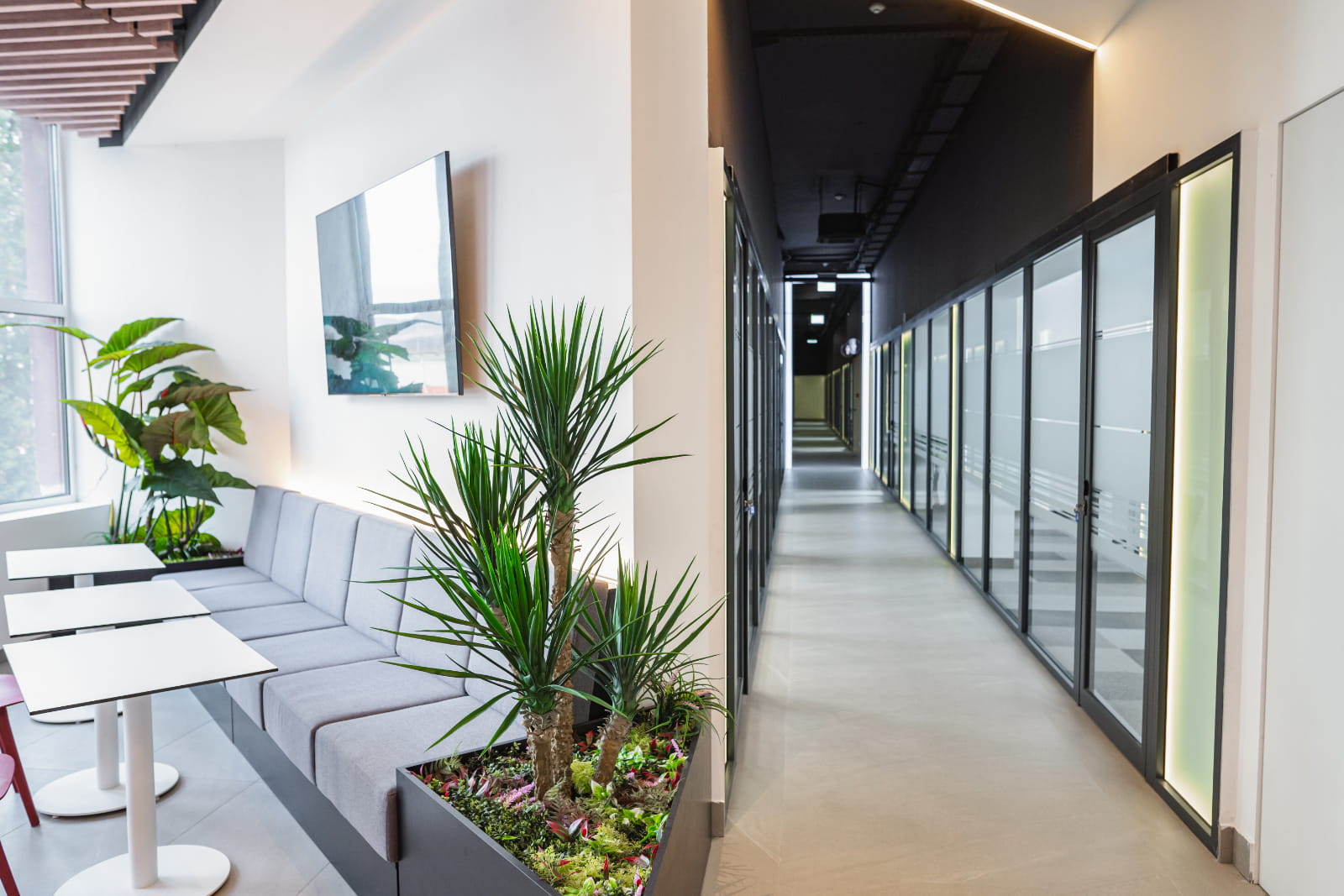
How to Balance Style, Budget and Durability in Office Finishes
Choosing the right office finishes means finding a workable balance between appearance, cost and long-term performance. Flooring, wall treatments, furniture, fabrics and joinery all influence how an office looks, but they also need to cope with everyday use. Selecting finishes purely because they are fashionable or inexpensive can create problems later if surfaces wear quickly, become difficult to maintain or no longer suit the way the workplace operates.
A better approach is to think about the entire life of the workplace from the start. Consider which spaces experience the most traffic, where employees spend the most time, what needs to be easy to maintain and where a stronger visual statement is genuinely worthwhile. This helps businesses direct their budgets towards materials that provide practical value while still creating an attractive and professional environment.
Start With How the Workplace Will Be Used
The first step is understanding how people actually use the office. A reception area, meeting room, open-plan workspace and staff kitchen may sit within the same building, but they experience very different levels of traffic, interaction and wear. Those differences should influence the finishes selected for each area.
Good space planning can reveal these patterns before materials are specified. Consider where employees gather, where visitors spend time, which routes experience the most movement and how different departments work together. Hybrid working should also form part of this assessment because occupancy levels may vary significantly throughout the week.
- Identify the busiest circulation routes through the office.
- Determine which spaces are occupied for long periods.
- Separate client-facing areas from internal working areas.
- Consider where furniture is moved or reconfigured frequently.
- Identify spaces where spills, moisture or heavy cleaning are likely.
- Account for changing occupancy and hybrid working patterns.
Once these patterns are clear, materials can be matched to their environment. Hard-wearing flooring may be justified in entrances and passages, while quieter meeting spaces could use softer finishes that improve comfort and acoustics. Kitchens and refreshment areas need surfaces that can handle moisture and frequent cleaning.
This approach also prevents overspecification. There is little benefit in paying for maximum durability in an area that receives very little use. By matching performance requirements to workplace activity, businesses can use their budget more intelligently while creating an office that still feels consistent from one area to another.
Set a Realistic Budget for Office Finishes
The budget for office finishes should account for more than the purchase price of individual materials. Installation, preparation, maintenance, repairs and eventual replacement can all affect the true cost. Lifecycle costing recognises these additional expenses, considering costs such as acquisition, installation, operation, maintenance, removal and disposal rather than looking at the initial price alone.
The wider workplace also needs to be considered. Furniture, storage, flooring, wall treatments, lighting, joinery, signage and construction work may all compete for the same project budget. Deciding which elements are essential before choosing decorative upgrades makes it easier to prevent costs from escalating during the design process.
A useful strategy is to identify a small number of areas where spending more will make a measurable difference. High-traffic floors, heavily used desks and client-facing spaces may deserve greater investment, while simpler materials can often work perfectly well elsewhere. Budgeting in this way is less about choosing the cheapest products and more about deciding where each rand provides the greatest long-term value.
Think About Lifecycle Cost, Not Just Purchase Price
An inexpensive finish can appear attractive when reviewing the initial fit-out budget, but replacement costs can quickly change the calculation. Materials that scratch, chip, stain or fade easily may need repairs or replacement long before more durable alternatives.
Lifecycle thinking takes the entire journey of a material into account. That includes manufacturing, transport and installation as well as maintenance, removal and disposal. Considering these stages makes it easier to identify products that may cost more initially but offer stronger long-term value.
- Compare expected service life between products.
- Ask how often a surface needs specialist maintenance.
- Check whether damaged sections can be repaired individually.
- Consider the labour cost involved in replacement.
- Look at whether replacement parts or matching materials will remain available.
- Factor workplace disruption into major maintenance decisions.
Durability becomes particularly important for flooring, desks, counters and storage that receive repeated daily contact. Replacing a damaged finish can involve much more than purchasing a new product. Existing materials may have to be removed, new products delivered and work areas temporarily taken out of use.
The best-value choice is therefore not automatically the least expensive one. Businesses should compare the expected performance of different options over several years and choose materials that are appropriate for the amount of use they will receive.
Match Office Finishes to Traffic Levels
Different parts of the workplace experience very different levels of wear. The entrance may see almost every employee and visitor who enters the building, whereas a small private meeting room could remain empty for much of the day. Treating those areas identically can lead either to unnecessary spending or premature deterioration.
Current workplace patterns make this particularly important. Global workplace benchmarking published in 2026 recorded average office utilisation of approximately 53%, while peak utilisation reached 80%. This illustrates how occupancy can change substantially depending on the day and reinforces the importance of understanding peak demand rather than relying only on average attendance.
- Use durable flooring in entrances and major circulation routes.
- Choose wipeable surfaces in kitchens and shared refreshment areas.
- Specify robust desk finishes for heavily occupied workstations.
- Consider stain-resistant fabrics for shared seating.
- Reserve delicate finishes for controlled, lower-traffic spaces.
- Review peak occupancy when assessing expected wear.
Traffic patterns can also help determine where premium materials will have the greatest effect. A distinctive reception counter or boardroom surface may contribute strongly to the office’s overall identity even though it covers only a relatively small area.
By creating different performance specifications for different zones, businesses can achieve a more balanced project. The workplace can still look cohesive, but the most durable materials are concentrated where they are genuinely needed.
Choose Flooring and Furniture for Everyday Performance
Flooring is one of the largest visual surfaces in an office and one of the hardest working. Carpet and carpet tiles can provide softness and help with acoustics, while vinyl, porcelain, timber-look products and concrete can offer different combinations of durability, maintenance requirements and visual character. The correct choice depends on how each space is used rather than which option looks best in isolation.
Furniture deserves the same practical assessment. People spend a significant proportion of their lives inside buildings, with environmental research estimating that people spend roughly 90% of their time indoors. That makes the quality of internal environments, including furniture, finishes and material emissions, particularly important. Furniture should therefore support ergonomics and daily use as well as the visual concept.
Material selection can affect indoor environmental quality too. Research into indoor air has found that concentrations of some pollutants can be several times higher indoors than outside, with building materials and furnishings among the possible contributing sources. Choosing suitable low-emission finishes, adhesives and furnishings can therefore form part of a more considered workplace specification.
Create a Premium Look Without Premium Materials Everywhere
A professional-looking office does not require the most expensive surface in every room. The impression created by an interior often depends more on consistency, proportion and detailing than on individual product prices.
Businesses can therefore concentrate more distinctive materials in areas where they make the greatest impact. Reception spaces, boardrooms and client meeting areas are obvious examples, while general working areas can use more economical products that still meet the required performance standard.
- Choose a limited range of complementary finishes.
- Spend more on prominent features rather than every surface.
- Repeat timber tones or textures to create visual continuity.
- Use lighting to strengthen simple materials.
- Introduce brand colours through controlled accents.
- Prioritise good edge detailing and hardware.
- Use custom joinery selectively where it adds noticeable value.
Simple finishes can also feel more refined when they are installed and coordinated properly. Matching hardware, neat junctions between materials and consistent furniture detailing can improve the overall impression without requiring a significant increase in material cost.
This creates room in the budget for areas where additional investment matters. Instead of spreading money thinly across dozens of premium products, businesses can develop a clear hierarchy between practical background finishes and selected visual features.
Keep the Material Palette Focused and Consistent
Too many unrelated colours, textures and materials can make even an expensive office look disjointed. A smaller palette usually creates stronger continuity because the same tones and details can appear across furniture, walls, flooring and joinery. It can also simplify procurement and make it easier to replace individual components later.
Consistency is increasingly important as offices become more flexible. Recent workplace benchmarking found global office occupancy had reached 111%, meaning some workplaces had more employees allocated to buildings than physical seats because rotating schedules and flexible working arrangements allowed spaces to be shared. In this type of environment, finishes need to work across spaces serving several functions instead of being designed around one fixed user.
A focused palette also creates flexibility when the office is updated later. Neutral foundation finishes can remain in place while fabrics, graphics, furniture and brand elements are refreshed. Businesses can therefore change the character of a space without replacing every floor, counter and wall surface whenever working patterns or visual identities evolve.
Balance Durability With Sustainability
Durability can be an important part of sustainable specification because products that remain useful for longer do not need to be replaced as frequently. This reduces demand for new raw materials while also limiting waste associated with removal, transport and disposal.
The scale of the issue is significant. Buildings and construction account for around 37% of global carbon dioxide emissions and close to 50% of global material extraction, according to 2025 to 2026 international building-sector data. Earlier reporting also estimated that construction and demolition activity generates about 2 billion tonnes of waste globally each year, equivalent to roughly one-third of global waste.
Businesses can respond by considering responsibly sourced materials, recycled content, modular furniture, low-emission finishes and products that can be repaired rather than discarded. Local production and custom furniture can also reduce unnecessary replacement where standard pieces do not suit the space. Sustainability is therefore not only about what materials contain, but how efficiently and how long they are used.
Plan Office Finishes Around Future Changes
Workplace requirements rarely remain fixed for the full life of an interior. Teams grow, departments move, technology changes and flexible working can alter how much space is needed from one day to another. Finishes that only work with one specific layout may become expensive obstacles when those changes occur.
Recent global workplace research demonstrates how quickly utilisation patterns can shift. Average building utilisation rose from 38% in 2024 to 53% in 2025 in one major global benchmarking programme. At the same time, peak utilisation reached 80%, showing why offices need to cope with both quieter periods and concentrated demand.
Modular furniture, adaptable storage and neutral background finishes can make changes easier. Instead of replacing major materials, businesses may only need to reposition furniture, adjust partitions or refresh selected visual elements. Planning for change from the beginning can therefore protect both the design investment and the project budget.
What Turnkey Interiors Offers You
At Turnkey Interiors, we consider furniture and finishes as part of the wider workplace strategy. We look at how people use the space, how different areas connect and what each part of the office needs to achieve before finalising material and furniture choices.
Our integrated approach allows design decisions to be coordinated with space planning, construction, furniture, joinery and project management rather than handled as isolated stages.
- We provide commercial and corporate interior design.
- We assist with workplace and space planning.
- We develop detailed project budgets.
- We coordinate procurement and implementation.
- We provide office furniture and bespoke joinery.
- We manufacture custom furniture through our in-house capabilities.
- We consider ergonomics, durability and aesthetics together.
- We can plan spaces around growth and changing workplace requirements.
Our custom furniture capability is particularly useful when standard products do not suit the available space. We can develop elements such as boardroom tables, reception counters, workstations, kitchens and storage around the wider interior concept, helping furniture and finishes work together visually and practically.
We also take future use into account rather than designing only for the day of handover. By combining design, budgeting, furniture, procurement and implementation within the same process, we can help clients make informed decisions about where to invest and where simpler solutions will provide better value.
Make Your Office Finishes Work Harder
The best office finishes are not necessarily the most expensive or the most fashionable. They are the materials that suit the workplace, cope with the amount of use they receive and remain practical over time. Looking at traffic, maintenance, lifecycle cost, sustainability and future flexibility allows businesses to create interiors that look considered without allowing the budget to become disconnected from operational needs.
At Turnkey Interiors, we can help bring those considerations together from the earliest stages of the project. We combine space planning, design, budgeting, furniture, custom joinery, procurement and implementation to create workplaces that balance appearance with long-term performance. Get in touch with us to discuss how we can help create an office that looks good, works well and continues delivering value as the business evolves.
FAQs About Office Finishes
What Are the Most Durable Office Finishes for Busy Workplaces?
What are the most durable office finishes for busy workplaces? Durable office finishes usually include commercial-grade flooring, quality laminates, engineered boards, robust metals, and stain-resistant fabrics. The best choice depends on how heavily each area is used. Entrances, passages, kitchens, and shared workspaces generally need tougher materials because they experience more foot traffic, cleaning, and everyday contact. Lower-traffic rooms can use more decorative finishes without the same performance demands. It also helps to consider repairability, maintenance requirements, and expected lifespan. A finish that costs more initially may offer better long-term value if it needs fewer repairs or replacements over time.
How Can I Make Office Finishes Look Expensive on a Limited Budget?
How can I make office finishes look expensive on a limited budget? A premium look does not require expensive materials throughout offices. Start with a coordinated palette and use stronger finishes in high-impact areas such as receptions, boardrooms, and client-facing spaces. More economical materials can be used in general work areas if they are detailed and installed properly. Consistent colours, matching hardware, neat edges, and repeated textures can make simple finishes feel more refined. Lighting, furniture, rugs, fabrics, and brand accents can also add depth. Spending selectively often creates a more polished result than spreading the budget across premium materials.
How Should I Choose Office Finishes for Different Areas?
How should I choose office finishes for different areas? Choose office finishes according to how each area is used, how much traffic it receives, and how easy it needs to be to maintain. High-traffic routes, entrances, kitchens, and shared spaces generally benefit from hard-wearing, easy-to-clean materials. Meeting rooms and private offices may allow softer or more decorative options because they experience less wear. Also consider acoustics, moisture, furniture movement, and cleaning frequency. Matching the finish to the function helps prevent overspending while reducing premature damage. It also creates a workplace that performs better over time and feels visually consistent overall.
Are Sustainable Office Finishes More Expensive?
Are sustainable office finishes more expensive? Sustainable office finishes are not always more expensive, although some may have a higher upfront price. Cost depends on the material, supplier, durability, installation requirements, and how long the product is expected to last. A durable finish with recycled content or responsibly sourced materials may provide better lifecycle value if it needs replacing less often. Businesses can also reduce waste by choosing modular furniture, repairable components, low-emission finishes, and materials that can be reused or recycled. Compare initial cost with maintenance, replacement frequency, and expected lifespan instead of judging sustainability by purchase price alone.
How Do Office Finishes Affect the Overall Workplace Design?
How do office finishes affect the overall workplace design? Office finishes shape how a workplace looks, feels, and functions. Flooring, wall treatments, furniture surfaces, fabrics, and joinery can influence brand identity, comfort, acoustics, maintenance, and perceived quality. A consistent material palette can make different areas feel connected, while selected colours and textures can distinguish meeting rooms, collaboration zones, and client-facing spaces. Finishes can also affect long-term performance, especially in areas exposed to heavy traffic or frequent cleaning. For the best result, choose them alongside space planning, furniture, lighting, and operational requirements rather than adding them as decorative decisions later altogether.


Leave a Reply