

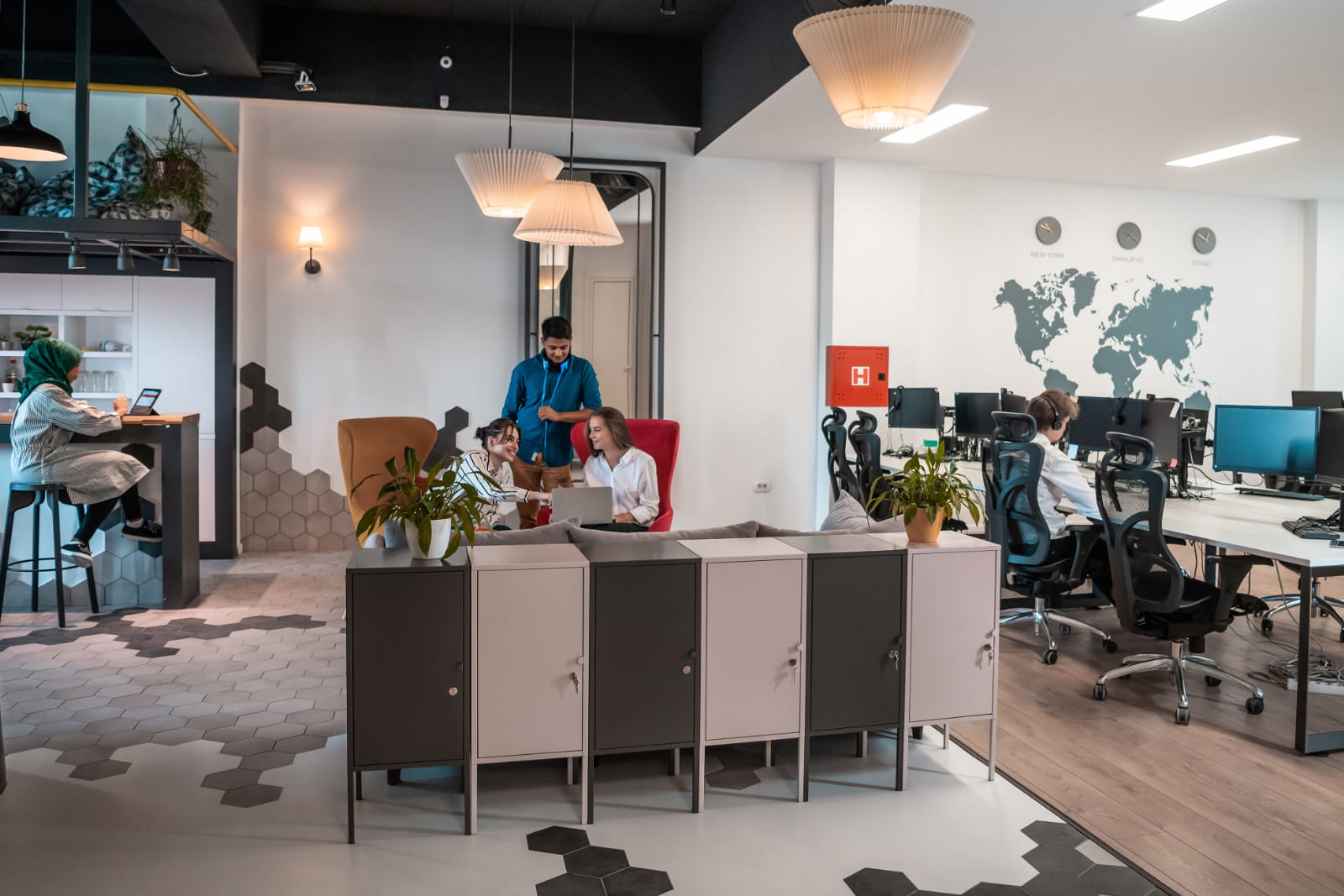
What Is Office Interior Styling and Branding Integration?
Office interior styling and branding is the process of making a workplace look, feel and function like the business behind it. Instead of limiting branding to a logo on the reception wall, it uses layout, colour, materials, furniture, lighting, signage and graphics to express the organisation’s identity. The goal is to create a consistent workplace experience for employees, clients and visitors.
Good branding integration still starts with practical workplace requirements. Employees need spaces where they can concentrate, collaborate, meet clients and take breaks comfortably. Branding should strengthen those activities instead of getting in their way. This means understanding how the business operates first, then using interior styling to turn its personality, values and visual identity into a working environment.
What Does Office Interior Styling and Branding Actually Involve?
Office interior styling and branding brings together visual design and practical space planning. Interior styling establishes the character of the workplace, while branding integration ensures those decisions connect with the organisation’s identity. The process can influence everything from the flooring underfoot to the way employees move between departments.
This does not mean every design element needs to feature a corporate colour or logo. Strong workplace branding is usually more subtle. A business that values innovation, for example, might express that through adaptable furniture and collaborative areas, while a company built around professionalism might favour structured meeting areas and refined finishes.
Typical elements include:
- Corporate and complementary colour palettes
- Furniture styles, fabrics and finishes
- Flooring, wall finishes and ceiling details
- Lighting and decorative features
- Reception and client-facing environments
- Workplace graphics and photography
- Signage and wayfinding
- Bespoke joinery and furniture
- Meeting, collaboration and breakout spaces
- Brand messages, values and company history
The important point is that these components should work together. Selecting a stylish chair, feature wall and sign independently can create a visually attractive office, but not necessarily a coherent branded environment. Each decision should contribute to a recognisable overall experience.
Function should guide those decisions too. Branding cannot compensate for poor circulation, uncomfortable furniture or insufficient meeting space. Integrating styling with workplace planning from the beginning makes it easier to create an office that communicates identity without sacrificing everyday usability.
Why Is Office Interior Styling and Branding Important?
The workplace is one of the few places where people can physically experience a brand. A website may communicate visual identity on a screen, but an office surrounds employees and visitors with materials, colours, sounds, spaces and furniture. This makes the workplace a particularly powerful opportunity to turn abstract values into something tangible.
Research also shows why the underlying quality of the environment matters. A 2024 global workplace study surveyed 16,040 full-time office workers across 15 countries. It found that 94% of employees in exceptional workplaces had a choice of where to work within the office. This suggests that effective workplaces combine identity with variety and practical choice rather than relying on aesthetics alone.
Office design can influence how people feel about coming to work as well. Research comparing workplace performance found that 94% of employees in high-performing workplaces said working from the office positively affected their individual productivity, compared with 45% in low-performing workplaces. Branding should therefore form part of a wider effort to make the workplace useful, comfortable and relevant to the people using it.
Start With Company Identity Before Choosing Colours
One of the easiest mistakes in office interior styling and branding is jumping straight to corporate colours. Colour matters, but it should follow a clearer understanding of the company. Before selecting finishes, businesses should determine what employees and visitors should feel when entering the workplace and which organisational qualities the space needs to communicate.
Think beyond purely visual questions. A company may value collaboration, sustainability, precision, creativity, trust or flexibility. Those ideas can affect the layout and materials just as much as the colour palette. An organisation promoting teamwork, for example, can demonstrate that value more convincingly through useful collaboration areas than through a slogan about teamwork painted on a wall.
Useful questions include:
- What should clients feel when entering the office?
- What does the company want employees to experience?
- Which company values should be visible in the workplace?
- How formal or informal should the environment feel?
- Which brand colours work naturally within an interior?
- Which materials suit the company’s personality?
- How should different departments interact?
- Which areas deserve stronger brand expression?
Once those questions have been answered, colour becomes easier to use intelligently. A bold corporate colour does not need to cover entire walls. It could appear in upholstery, acoustic features, artwork, meeting rooms, flooring details or signage.
Neutral colours can provide balance around stronger accents. Softer versions of corporate colours can also work in concentration areas where highly saturated colours might become distracting. This creates a workplace that remains recognisable without turning the interior into an oversized advertisement.
Use Layout to Express Company Culture
Office culture is communicated through the floor plan as well as decorative choices. A business that encourages teamwork may need informal meeting areas, collaboration zones and shared project spaces. Organisations handling sensitive information may require more enclosed meeting rooms, acoustic privacy and quieter individual workspaces.
Workplace research supports the need for variety. Global office workers reported spending around 42% of their working time working with other people, both in person and virtually. At the same time, focused individual work was reported as one of the most important reasons for attending the office. An effective layout therefore needs to support collaboration without treating every task as collaborative.
This is where branding and space planning meet. A company might describe itself as flexible, collaborative or people-focused, but its workplace should provide physical evidence of those qualities. Offering several useful settings for different tasks allows the office to communicate culture through everyday behaviour rather than relying only on visual messages.
Integrate Brand Colours Without Overdoing Them
Colour is one of the quickest ways to create recognition, but more branding does not automatically mean better branding. Applying one corporate colour to walls, furniture, flooring and graphics can create visual fatigue and make individual features less meaningful. A controlled palette normally produces a more sophisticated result.
Colour should also respond to the function of the space. Industry guidance commonly places office task lighting at around 300 to 500 lux, demonstrating that visual environments are about more than colour alone. Lighting levels, glare, material reflection and contrast all affect the way colours and finishes are experienced.
A practical approach is to establish a neutral base and then use corporate colours at selected touchpoints. Stronger colours might identify collaboration or social spaces, while quieter shades can work around focused workstations. This allows different areas to have their own atmosphere without losing visual consistency across the office.
Let Materials and Furniture Support the Brand
Materials influence how a workplace feels before anyone reads a sign or notices a logo. Timber and textured fabrics can create warmth, while glass, smooth surfaces and clean architectural lines can communicate a more contemporary character. Material choices should therefore reflect the organisation’s personality while still being appropriate for maintenance, traffic and everyday use.
Furniture provides another layer of brand expression. Flexible businesses may favour movable or modular pieces, while formal client environments could require a different furniture language. The right choice should consider appearance, comfort, durability, ergonomics and the way each area will actually be used.
Brand-supporting choices could include:
- Custom reception counters
- Bespoke boardroom tables
- Branded upholstery or fabrics
- Modular collaboration furniture
- Integrated storage
- Feature timber or textured surfaces
- Coordinated workstation finishes
- Custom cabinetry and joinery
- Furniture scaled to particular workplace zones
These details are particularly effective because they combine function with identity. A custom reception counter, for example, performs an essential practical job while also becoming one of the first pieces of the brand experience that a visitor encounters.
Durability matters as much as appearance. High-traffic reception, circulation and social areas experience different levels of wear from quiet meeting rooms. Matching materials and furniture to actual use helps protect the visual quality of the workplace long after installation.
Turn Reception Areas Into a Brand Experience
Reception creates an immediate impression because it is often the first part of the workplace clients, candidates and other visitors experience. The brand message begins before somebody sees a logo. Lighting, materials, furniture, signage, acoustics and even the route from the entrance to reception contribute to the overall impression.
Lighting deserves particular attention. Research into healthy workplaces notes that lighting can account for up to a quarter of office energy use, while access to daylight has also been associated with employee wellbeing. One study referenced in wider workplace research found that workers with windows slept an average of 46 minutes longer per night than workers without windows.
Reception styling should therefore combine aesthetics with comfort and practicality. Clear signage, appropriate lighting, comfortable waiting furniture and a recognisable material palette can communicate professionalism without overwhelming visitors with branding. That same visual language can then continue into meeting rooms and other client-facing areas.
Use Graphics and Signage With Purpose
Graphics can communicate much more than a logo. They can tell the organisation’s story, explain its values, celebrate achievements or bring relevant imagery into the workplace. Corridors, meeting areas and shared spaces provide opportunities to add visual interest without consuming valuable working space.
Signage has an equally important practical role. People need to locate meeting rooms, facilities, departments and exits easily. Branding can influence typography, colours, materials and graphic style, but clarity should always come first.
Useful applications include:
- Reception logos and identity features
- Company timelines
- Values and mission statements
- Project or product imagery
- Employee achievements
- Branded meeting-room graphics
- Privacy graphics on glazed partitions
- Directional signs
- Room identification
- Department or zone markers
Graphics should be positioned where they have meaning rather than added simply because a wall is empty. A company timeline can work well along a circulation route, for instance, while strong imagery may help establish the personality of a collaboration or social area.
Consistency is important too. Using unrelated fonts, materials and sign styles across different areas can weaken the overall identity. Establishing a clear visual system helps visitors navigate the workplace while making the branding feel deliberate.
Bring Branding Into Employee Spaces Too
Client-facing areas are important, but employees generally experience the workplace for much longer periods. Branding should therefore continue into kitchens, breakout spaces, meeting rooms, work areas and other internal environments. This helps make the company’s identity part of everyday working life rather than something reserved for visitors.
The quality of these spaces can influence workplace experience. Global research has found that employees in effective, experience-rich workplaces report substantially stronger productivity outcomes than those in poorly performing workplaces. Another finding showed that 92% of employees in high-performing workplaces said the office positively affected decision-making speed, compared with 43% in low-performing environments.
Internal branding works particularly well when it supports genuine company priorities. A business promoting wellbeing could emphasise natural light, comfortable furniture and quieter settings. One promoting collaboration could provide practical team spaces. Employees then experience those values through the workplace itself instead of simply reading about them.
Balance Brand Expression With Practical Office Design
A strong brand identity cannot rescue an uncomfortable office. Acoustics, lighting, circulation, privacy, temperature, furniture and storage still determine whether employees can use the workplace effectively. Research involving 259 workers across 38 offices found that sound and temperature were the leading environmental factors affecting reported productivity, with office layout also showing a significant relationship.
Acoustic planning is therefore particularly important in open workplaces. Conversations, ringing phones and equipment noise were among the most disruptive sources identified in that research. Meeting rooms, acoustic treatments, zoning and quiet areas can help ensure an open and visually attractive office does not create constant distraction.
Future change should also be considered. Teams expand, departments reorganise and working patterns evolve. Adaptable furniture, sensible circulation and flexible room layouts can help the office respond without requiring a major redesign whenever something changes. Good branding integration creates a recognisable identity while leaving the workplace practical enough to evolve with the business.
Who Offers Office Interior Styling and Branding Integration?
At Turnkey Interiors, we approach office interior styling and branding as part of the wider workplace design process. We begin by understanding how the business operates, what employees need, how teams interact and what the organisation wants its workplace to communicate. This allows branding decisions to grow out of genuine business requirements instead of being added as decoration once the layout has already been decided.
We have been operating in the South African workplace sector since 2001, with teams in Johannesburg and Cape Town. Our integrated offering means we can consider branding alongside space planning, corporate and commercial interior design, office construction, furniture, bespoke joinery, project management and building modification.
Our services can bring together:
- Workplace consultation and needs analysis
- Space planning
- Interior design and conceptualisation
- Corporate identity integration
- 3D visualisation
- Material and finish selection
- Furniture specification
- Bespoke joinery
- Office construction and fit-out
- Costing and procurement
- Project management
- Quality control and final handover
Because these elements can be coordinated as part of the same project, we can consider branding much earlier in the process. A custom reception counter, meeting-room finish or branded furniture feature can be designed alongside the surrounding construction rather than treated as an isolated addition.
Our aim is to make identity and functionality support one another. We can help create workplaces that communicate what an organisation represents while still responding to workflow, employee requirements, available space, budget and future growth.
Make Office Interior Styling and Branding Part of the Bigger Picture
Effective office interior styling and branding turns corporate identity into something people can experience rather than simply see. Colours, furniture, materials, graphics and signage all play a role, but the strongest results happen when those details are connected with space planning, workplace culture and everyday employee needs. Branding then becomes part of how the office functions rather than a decorative layer applied at the end.
At Turnkey Interiors, we bring together workplace planning, interior design, furniture, construction and project management to create coordinated office environments. If your existing workplace no longer represents your organisation, or you are planning a new space and want branding integrated from the beginning, get in touch with us to discuss how we can turn your brand identity into a practical, engaging workplace.
FAQs About Office Interior Styling and Branding
What Is Office Interior Styling and Branding Integration?
Office interior styling and branding integration is the process of designing a workplace so its colours, materials, furniture, layout, signage and atmosphere reflect the company’s identity. It goes beyond placing logos on walls by linking visual choices with company values, culture and the way employees work. A strong design might use brand colours selectively, include custom furniture, add graphics that tell the company story and create spaces that support collaboration or focus. The aim is to make the office feel recognisable and consistent with the wider brand while remaining comfortable, functional, practical and suitable for everyday business operations and visitors.
How Does Office Branding Affect Employees?
Office branding can influence employees by making the workplace feel more connected to the organisation’s culture, values and identity. When branding is integrated thoughtfully, it can support a sense of belonging and help employees understand what the business stands for. The effect is strongest when visual branding is supported by practical design. For example, a company that values collaboration should provide suitable team spaces, while a wellbeing-focused business may prioritise natural light, comfortable furniture and quiet areas. Branding should therefore reinforce workplace behaviours rather than rely only on logos, slogans or colours to communicate company culture to employees every day.
How Should Brand Colours Be Used in an Office?
Brand colours can be used in office interiors without overwhelming the space by applying them selectively rather than across every surface. Strong colours can appear in upholstery, acoustic panels, signage, graphics, meeting rooms or small feature areas, while neutral finishes provide balance. Softer versions of the corporate palette can also work well in quieter work zones. The best approach is to consider how each colour supports the purpose and mood of an area. This creates consistency without making the office feel repetitive. Lighting, materials and surrounding finishes should also be considered because they can change how colours appear in practice.
Can Office Branding Be Integrated Without a Complete Refurbishment?
Office branding can be integrated without a complete refurbishment. Businesses can update selected elements such as wall graphics, signage, paint colours, furniture, upholstery, artwork, lighting or reception features to strengthen brand identity. Existing meeting rooms and breakout areas can also be refreshed with new finishes or graphics that better reflect the company’s values. However, larger problems involving poor space planning, circulation, acoustics or outdated layouts may require more extensive changes. Before deciding, businesses should assess what is currently working, which areas create the biggest impression and where targeted improvements could deliver the most noticeable change without unnecessarily replacing workplace elements.
When Should a Business Use Professional Office Interior Styling and Branding Services?
A business should consider professional office interior styling and branding when its workplace no longer reflects its identity, culture or way of working. This often happens after rebranding, rapid growth, relocation, restructuring or changes in hybrid working patterns. Professional input can also help when branding feels inconsistent across reception, meeting rooms and employee areas. A workplace specialist can connect branding decisions with space planning, furniture, lighting, finishes and construction so the result is practical as well as consistent. This is particularly useful when a project involves multiple areas, custom features, budgeting, compliance requirements or coordination between design and implementation teams.


Leave a Reply